

This is the question I get more than any other right now. Maybe you're moving to Fort Carson, finishing up at Peterson, or you've been here ten years and your lease is up. Either way, the call to rent or buy in 2026 lands differently than it did a few years ago. Rates are higher than they were in 2021. Prices have leveled off but haven't crashed. And rent isn't cheap.
So let's walk through it. No pressure, no pitch — just the way I'd explain it to a friend over coffee, with the actual numbers in front of you.
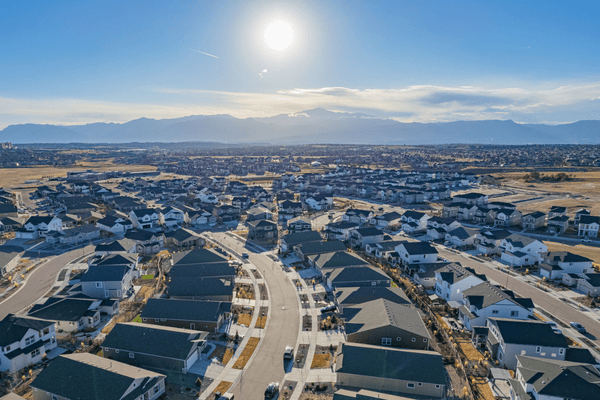
The 2026 Colorado Springs Market in Plain Terms
Here's where we are. Median sale prices in El Paso County have held in the high-$400s, with most of the activity between $400K and $550K. Mortgage rates have been sitting in the mid-6% range — you can track the weekly average through Freddie Mac's Primary Mortgage Market Survey. That's well off the lows of 2021, but also off the peaks we saw in late 2023.
Inventory is healthier than it has been in years. You actually have choices again — time to think, room to negotiate, and homes sitting on the market long enough to give you leverage. Sellers are pricing more realistically because they have to.
Rent has not gotten cheaper. A typical 3-bedroom single-family home runs between $2,200 and $2,800, depending on neighborhood and condition. A comparable mortgage payment with little to nothing down often sits in the same range — sometimes higher, sometimes lower, depending on the property and your loan.
When Renting is the Right Call
Buying isn't always the right answer. I've talked clients out of buying more than once. Here's when renting is the smarter call:
- You're going to PCS or relocate within 2 years. Buying and selling inside two years usually costs you money. Closing costs, agent fees, and any market dip eat into your return. Rent and protect your liquidity.
- You don't have your down payment, reserves, or closing costs squared away yet. Stretching into a home with nothing in the bank is how people end up house-poor.
- Your job, marriage, or family situation is in flux. A house anchors you. If you need flexibility for the next 12–18 months, keep it.
- Your credit needs work. Six months of paying down balances and not missing a payment can save you tens of thousands over the life of a loan.
If any of these describe where you are right now, rent. Use the time to get the rest of your situation lined up. Buying when you're not ready is worse than waiting another year.
When Buying in 2026 is the Right Move
On the other side, there are real reasons to buy now, even with rates where they are:
- You're planning to be here 3+ years. Time in the property beats every other variable.
- You have stable income and reserves — down payment, closing costs, and 3–6 months of expenses in the bank.
- You're tired of rent increases. A fixed mortgage payment doesn't move. Your landlord's rate of return does.
- You qualify for a VA loan. This one's big enough to get its own section below.
- You want to build your own equity instead of someone else's. Every rent check builds your landlord's net worth. Every mortgage payment builds yours.
Rates are a real factor, but they aren't permanent. You buy the house; the rate is temporary. Refinance when the market gives you a reason to. A lot of the buyers I worked with in 2025 are already on their second loan.
Running the Numbers: Rent vs. Buy
Let's put real numbers on it. Here's a $450,000 home in the Springs with $0 down at roughly 6.125% (APR 6.436%).
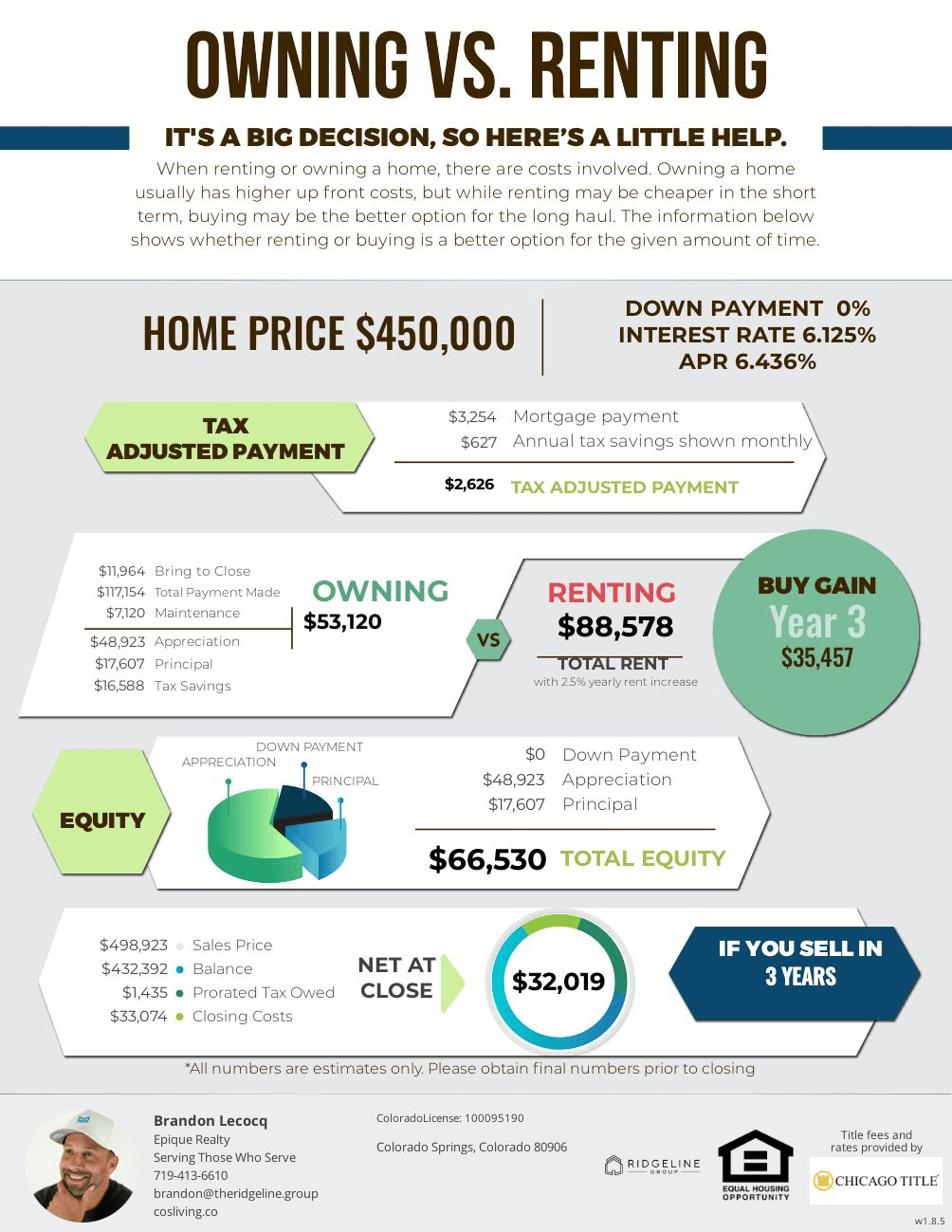
A $450,000 example with $0 down. Over three years, buying comes out about $35,457 ahead of renting. Estimates only — your real numbers depend on the home, your loan, and your timeline.
On the surface, renting looks cheaper month to month. But the monthly number hides what's actually happening. Run it out three years and the picture flips:
- Rent costs you about $88,578 over three years — an average of roughly $2,461 a month once you factor in a modest 2.5% annual rent increase. That money is gone.
- Owning nets out to about $53,121 over the same three years, after you subtract appreciation, the principal you've paid down, and your tax savings.
- That's about a $35,457 swing in your favor — money that lands in your pocket instead of your landlord's.
The reason is simple: a chunk of every mortgage payment is principal — that's your money, not a payment to someone else. Rent only goes up. A fixed mortgage doesn't. And you keep the appreciation, not your landlord.
One Colorado note worth knowing: our property taxes are among the lowest in the country, so the tax portion of a Colorado Springs payment is usually smaller than national calculators assume. The estimates above are a starting point — we'd run your exact numbers before you decide anything.
What You Actually Walk Away With
The monthly comparison is only half the story. The other half is what you own at the end. Here's the same $450,000 example, broken all the way down.
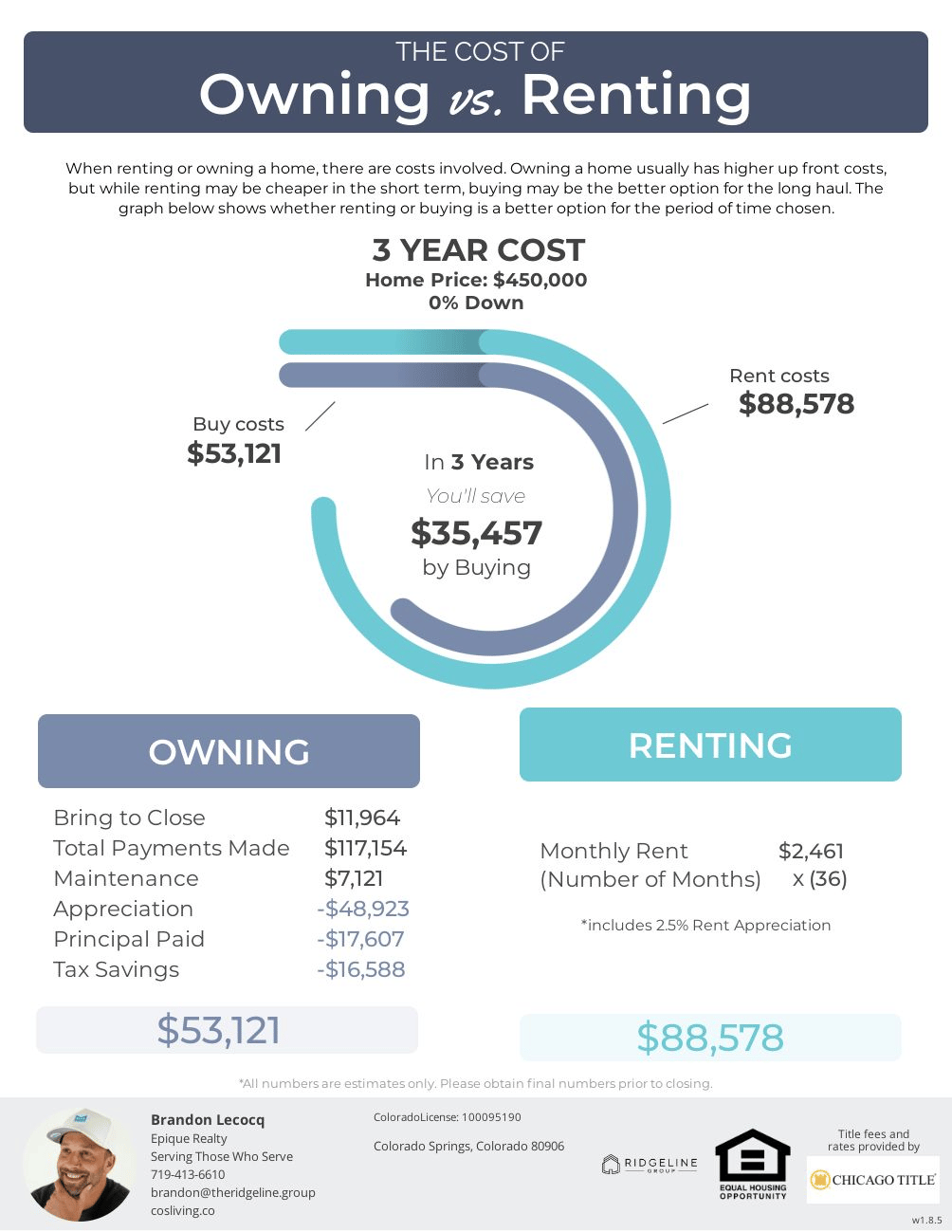
The same example, in detail. You build roughly $66,530 in equity over three years and net about $32,019 if you sell in year three. Estimates only.
A few things stand out:
- Your tax-adjusted payment is about $2,626 a month — right in the range you'd pay to rent a comparable home, except this payment is building something.
- You build roughly $66,530 in equity in three years — $48,923 from appreciation and $17,607 from principal paydown, on a home you put $0 down on.
- If you sold in year three, you'd net about $32,019 after the loan payoff, prorated taxes, and closing costs.
That last number is real money you can carry to your next home — or your next duty station. A renter walks away with their security deposit. (One caveat on the tax savings baked into these estimates: that benefit mainly helps if you itemize. Most filers take the standard deduction now, so check with a tax pro on your situation. The IRS mortgage interest deduction guidance, Publication 936, covers the rules.)
Military Families and VA Buyers
If you're active duty, a veteran, or a surviving spouse, the math changes in your favor. The VA loan is one of the most powerful homebuying tools in the country, and most people who qualify don't fully understand what they're holding.
Here's what makes it different:
- No down payment. You can buy without putting money down — which is exactly the scenario in the example above.
- No monthly mortgage insurance. Conventional buyers with less than 20% down pay PMI, sometimes $200+ a month. You don't.
- More flexible credit and debt-to-income guidelines than conventional loans.
- The benefit is reusable. You can use it again after you sell, and in some cases hold two VA loans at once.
One honest detail so nothing surprises you: most VA buyers pay a one-time funding fee — 2.15% of the loan for first-time use with nothing down — which can be rolled into the loan. If you have a service-connected disability rating, you're typically exempt and pay nothing. The VA's funding fee and closing-cost page lays out who pays and who's exempt.
I've watched buyers PCS into Fort Carson, buy with $0 down, live in the home a few years, and walk away with real equity when orders sent them to their next base. That's not a guarantee — but it happens, and it doesn't happen when you rent. Start with the VA's home loan program page for eligibility and entitlement, then we can talk about what it looks like in this market.
If you're PCSing in within the next six months, my Colorado Springs Relocation Guide covers the timeline, what to handle before orders, and which neighborhoods fit which base. (My full breakdown of the VA loan advantage for Colorado Springs buyers goes deeper on the loan itself.)

The One Question I Ask Every Buyer
When someone tells me they're trying to decide whether to rent or buy, I ask one thing:
How Long Do You Plan to Be in the Home?
If the answer is less than 2 years, rent. If it's 3+, buy — as long as your financials are in order. If it's somewhere in between, we sit down and run the numbers for your actual situation: your income, your loan options, the neighborhoods you're considering, and the homes that fit.
There's no universal right answer. Anyone telling you to always buy or always rent is selling you something. The right call depends on your timeline, your finances, your goals, and the specific home in front of you.
Bottom Line
- The 2026 Colorado Springs market is more balanced than it's been in years — more inventory, more room to negotiate, and rates that aren't going back to 3%.
- Renting is the right move if you're leaving within 2 years, your finances aren't ready, or your life is in flux.
- Buying makes sense if you'll be here 3+ years, you have stable income and reserves, and you're done feeding someone else's equity.
- Run the full picture, not just the monthly payment. On a $450K example with $0 down, buying came out about $35,457 ahead over three years — and built around $66,530 in equity.
- VA buyers have the biggest advantage in this market. If you qualify and you're not using it, you're leaving real money on the table.
If you want to walk through your situation — what you can qualify for, what your monthly would actually look like, and whether buying or renting makes more sense on your timeline — reach out.
If you want to walk through your specific situation — what you can qualify for, what your monthly would actually look like, whether buying or renting makes more sense given your timeline — reach out.
No pressure, no pitch. Just a conversation.
And if you want weekly market updates, neighborhood breakdowns, and straight-talk content like this delivered every Sunday, sign up for the Ridgeline Rundown newsletter here.