
An appraisal gap happens when the lender's appraiser values a home for less than the price the buyer and seller agreed to. The lender funds off the appraised value, so that difference becomes cash somebody brings, a price somebody drops, or a deal somebody walks away from. It's not the end of your transaction — it's a negotiation you didn't plan for.
(Your offer price becomes the contract price the moment the seller signs. Lenders and appraisers use "contract price," so that's the term below. Same number.)
What is an Appraisal Gap and Why does It Matter?
Your lender orders an appraisal. The appraiser pulls recent comparable sales ("comps"), adjusts for differences, and issues an opinion of value. For a standard purchase mortgage, the lender sizes your maximum loan against the lower of appraised value or contract price. Under contract at $520,000 with an appraisal at $500,000, the lender uses $500,000. That $20,000 is the appraisal gap.
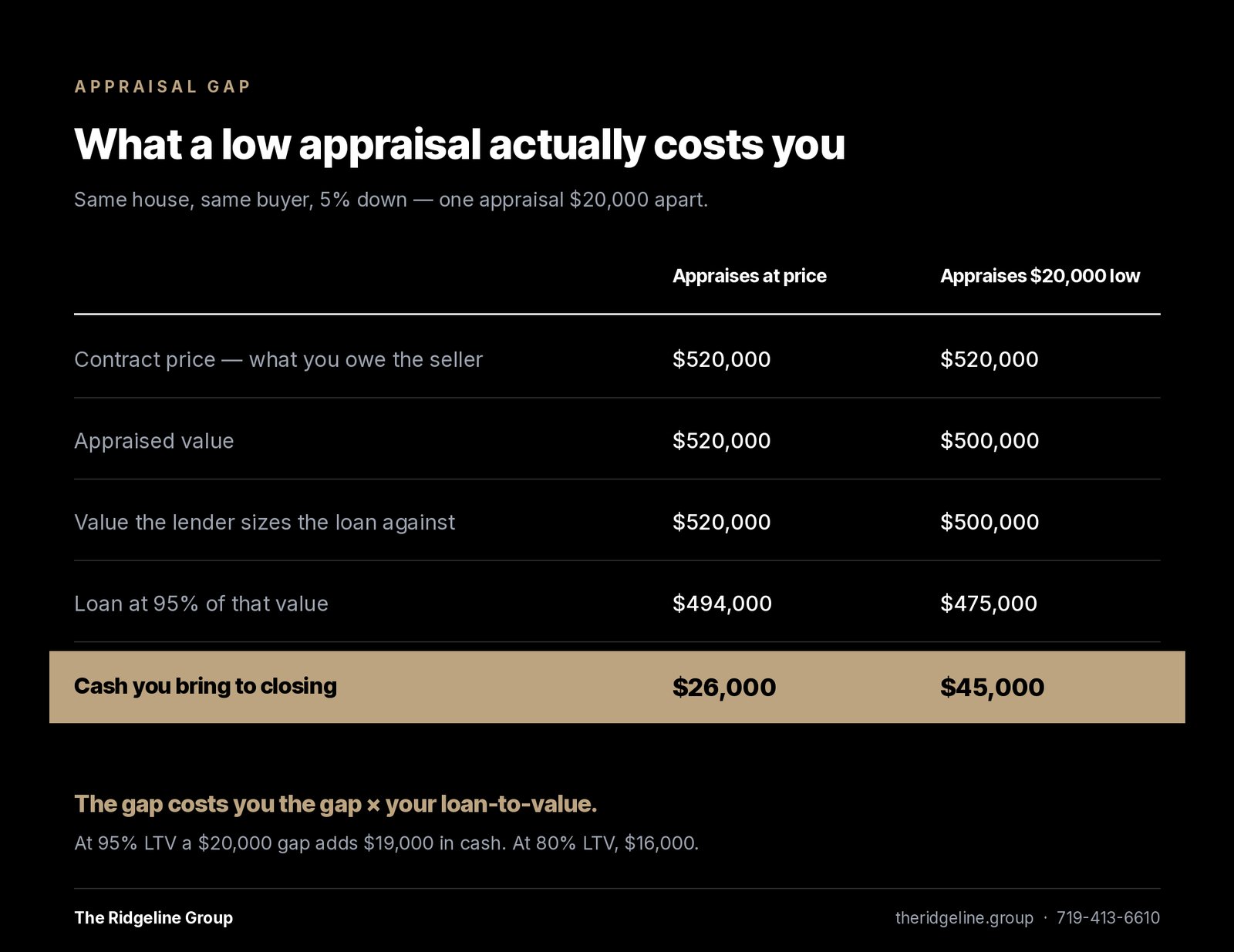
Unless you renegotiate, you still owe the seller $520,000. What changes is the value the loan is sized against, and the difference lands on you in cash.
One detail most explanations skip: your cash rises $19,000, not the full $20,000, because the 5% you were already putting down covered $1,000 of the gap. At 20% down it costs $16,000. The gap costs you the gap times your loan-to-value.
This isn't rare, but it isn't the norm. FHFA reports appraisals came in below contract price in 7 to 9 percent of transactions a year from 2013 to 2020, spiking to 15 percent in 2021 before settling back in early 2023. And the deal usually changes: in a Fannie Mae study of 2011–2012 purchases, 51% of low appraisals ended in a renegotiated lower price, 32% were delayed or cancelled, and only 15% closed at the original price.
Why Do Appraisals Come in Low?
Usually one of five things:
- The comps don't support the price. Appraisers look backward at closed sales, which lag what buyers are paying today.
- Multiple offers pushed past the data. A bidding war creates a price, not a comp — not until that sale closes.
- The appraiser missed something. A finished basement, a new roof, a $40,000 kitchen — none of it counts if it isn't documented.
- The appraiser isn't local. Someone driving down from Denver may not know why a home near Fort Carson trades differently than one in Monument.
- The home was priced on hope. The list price was never supported by the market.
Most gaps are small — in the Fannie Mae data, 53% of price cuts were under 5%. My own read, not a statistic: a double-digit miss is usually a pricing problem, and a second appraisal won't change what the comps say.
The most useful line here: appraisers are supposed to make "time adjustments" when prices moved after the comps closed. FHFA found they should have adjusted about 64% of comps and actually adjusted 13%. Your agent can raise that by name.
What Are Your Options When the Appraisal Comes in Low?
Five. Everything else is a variation.
- The seller drops to appraised value. Cleanest fix. Depends on the seller's competition.
- The buyer brings the difference in cash. On top of the down payment, out of pocket.
- You split it. Fannie Mae's researchers found buyers negotiate down about 50 cents for every dollar the appraiser came in short — a partial split is the statistically normal outcome, not a compromise nobody takes.
- You challenge the value. A Reconsideration of Value, below.
- You terminate. With an appraisal contingency, inside the deadline, the buyer walks and keeps their earnest money. (More on contingencies and deadlines in What Happens After You Accept an Offer.)
What you can't do is ask the lender to ignore the appraisal.
What Is Appraisal Gap Coverage — and Should You Offer It?
It's a clause promising to cover a low appraisal up to a stated amount — "Buyer will cover up to $15,000 of any appraisal shortfall." In multiple offers it's a strong term, because it tells the seller the deal won't die over value. That's my read on how sellers weigh offers, not a published statistic.
It's a commitment, not an intention, and it sits on top of your down payment. Cover a gap and you own a home worth less on paper than you paid. Run the number first: if $15,000 empties your reserves the month you move in, that's a risk you haven't priced.
How Do You Challenge a Low Appraisal?
The formal process is a Reconsideration of Value (ROV). You're not asking for a new appraiser — you're giving the existing one information they didn't have. It works when you bring facts, not feelings.
What moves the number:
- Better comps. Closed sales the appraiser didn't use, and why they're more comparable.
- Documented improvements. Receipts, permits, dates. "We remodeled" isn't evidence. A $38,000 invoice from four months ago is.
- Factual corrections. Wrong square footage, bedroom count, or lot size.
- Market timing. Data showing the market moved between the comps closing and your contract date.
A real one: an appraisal came in low and the listing agent's ROV letter was thin. I rebuilt it with the detail and comps that were missing, and the appraiser came back $22,000 higher — the difference between closing and not closing.
On conventional loans sold to Fannie Mae or Freddie Mac this got easier. Since October 31, 2024, Fannie Mae requires lenders to run a formal borrower-initiated ROV process and to give you a written disclosure explaining it when they deliver your appraisal. It's a documented process, not a favor.
Two limits: one ROV per appraisal, and up to five comps with it. One shot.
VA and FHA Buyers: What's Different
If you're using a VA loan, you have a protection most buyers don't: the Tidewater Initiative.
When a VA appraiser believes value will land below contract price, they notify the lender before finalizing the report. The point of contact gets two working days to submit additional closed comps, and the appraiser must address that information — including why it didn't change the value.
Conventional and FHA buyers don't get that VA pre-finalization window. Conventional borrowers can use the ROV process described above; FHA review procedures are different, as explained below.
VA buyers also have the VA Amendatory Escape Clause: if the home appraises below the purchase price, the buyer can back out and recover earnest money without penalty. Confirm it's in your contract before you're under contract. Details: VA's home loans page.
FHA buyers, the rules moved. Your appraisal is valid 180 days under HUD Handbook 4000.1. FHA adopted a borrower-initiated ROV process in 2024, but HUD rescinded it on March 19, 2025 through Mortgagee Letter 2025-08 — that federally guaranteed appeal is gone. FHA still has review procedures; ask your lender what's available under current HUD guidance rather than assuming the conventional process applies.
What Sellers Should Do When the Appraisal Comes in Low
Not your problem to solve — but it is your deal on the line.
- Ask the buyer for the report. Under the federal ECOA valuations rule the buyer gets a free copy, promptly on completion or three business days before closing. You don't — the ask goes through your agent to theirs.
- Read the comps, and hand over your improvement list. A sale from a different subdivision or one without your upgrades is challengeable. Roof, HVAC, windows, kitchen, with dates and costs.
- Weigh the alternative honestly. If this buyer walks, the next lender orders a new appraisal off the same comps. Nothing changes because the buyer changed. Sharper still if you're selling on a deadline.
Local context: PPAR figures for July 2026, via KOAA News 5, put the El Paso County median single-family price at $503,700 with 37 days on market, flat year over year. In a flat market appraisers have plenty of recent comps and little room to stretch.

Frequently Asked Questions
Can I just get a second appraisal? No. Fannie Mae's ROV guidance is explicit: once an ROV is decided and the value doesn't change, you can't demand a new appraisal — accepting the appraiser's conclusion is the lender's call. Switching lenders triggers a new appraisal but restarts your timeline, costs another fee, and guarantees nothing.
Does a low appraisal mean I'm overpaying? Not necessarily. It means closed sales don't yet support the price. In a rising market the appraisal reflects where the market was. In a flat market, take it seriously.
What happens to my earnest money if I walk? With an appraisal contingency and a timely termination, you get it back. Miss the deadline and you're exposed.
Bottom Line
- Lenders fund off the lower of the appraised value or contract price. The gap costs you the gap times your loan-to-value.
- Five options: seller reduces, buyer brings cash, split it, challenge the value, or terminate.
- Gap coverage is a real cash commitment. Run the numbers first.
- An ROV works on comps, receipts, and corrections — not opinions. One per appraisal.
- Watch your contingency deadlines. They protect your earnest money.
If you're under contract and the appraisal came back low, don't guess at it. Call me and we'll read the report together.
Brandon Lecocq — The Ridgeline Group
- Phone: (719) 413-6610
- Email: [email protected]
Want this before you need it? Sign up for the weekly newsletter — Colorado Springs market numbers and plain-English explanations, once a week.