What Colorado Springs Appreciation Trends Look Like Right Now
Let's start with the uncomfortable part.
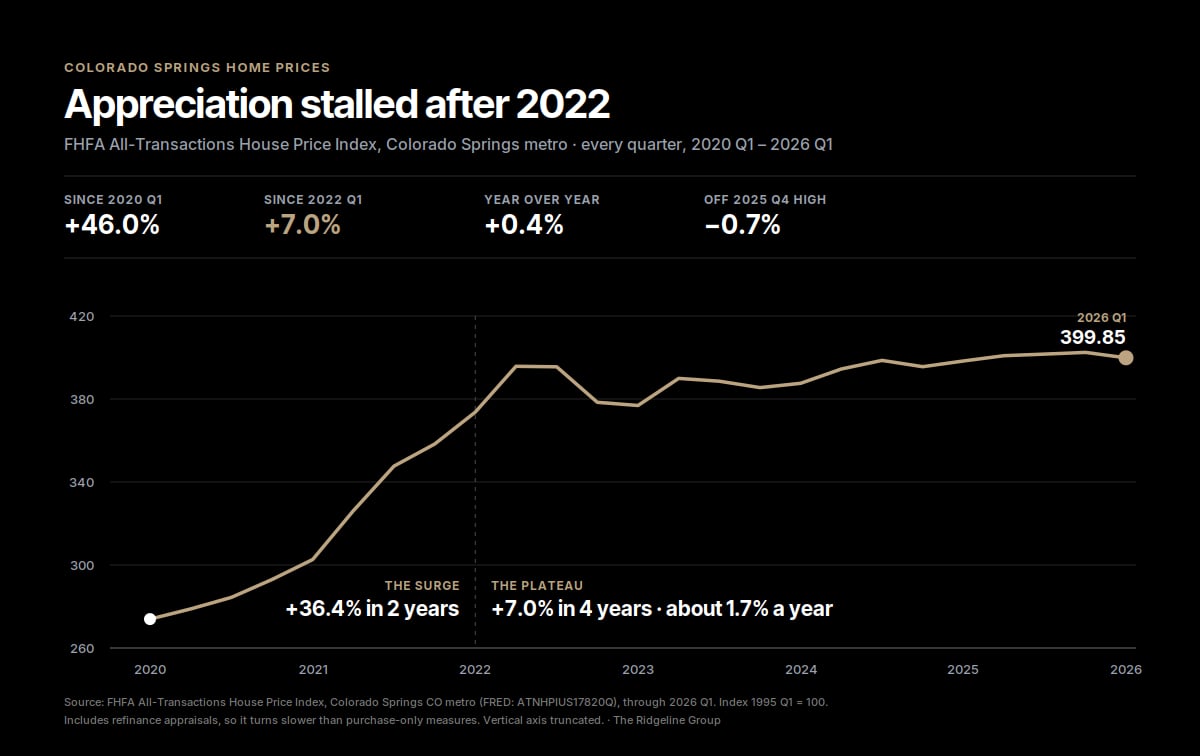
Home values in Colorado Springs have been basically flat for about three years. Per the Pikes Peak Association of REALTORS®, the median single-family home sold for around $499,900 in June 2026 — essentially unchanged from a year ago. The average sale price came in near $577,638, up only about 1%. Whether you look at the median or the average, the story is the same: prices are holding, not climbing.
A few other numbers worth knowing:
- Days on market are stretching. Homes took an average of about 45 days to go under contract in June 2026, roughly 12% longer than the same month last year.
- Inventory has stopped climbing. Active listings held around 4,000 — flat year over year, which is a change from the steady increases of 2024 and 2025.
- Rates are stuck in the mid-6s. Freddie Mac's weekly survey had the 30-year fixed at 6.58% on July 23, 2026. It's been trading in a narrow band since May.
Forecasts for the rest of the year cluster between flat and 3% appreciation. Locally, most people I talk to expect a slow first half and slight appreciation toward year-end. Normal for this market — historically — is closer to 3–4% annually.
So the honest read is this: appreciation is not going to carry a deal in 2026. If your model needs 8% a year to work, the model is wrong, not the market.
Why Flat Isn't the Same as Weak
Here's what I keep telling investors who call me nervous.
Flat prices in Colorado Springs aren't happening because people stopped wanting to live here. They're happening because payments got expensive at the same time a lot of new supply hit at once. Demand didn't leave. It just got priced into a smaller box.
The underlying economy hasn't softened:
- Fort Carson supports roughly 30,000 positions — about 23,700 active-duty soldiers plus another 5,400 civilian employees and 1,450 contractors — making it one of the largest employers in the state, with a $2.55 billion annual economic impact.
- The region is home to 150-plus aerospace and defense companies and a sector workforce more than 100,000 strong across Peterson, Schriever, and Cheyenne Mountain — about $3.1 billion in annual economic impact. You can see the scope on the Colorado Springs Chamber & EDC aerospace and defense page.
- In May 2026, leaders announced a $250 million Space Force operations facility at Schriever, plus the relocation of the Space Force's Infrastructure Portfolio Acquisition Executive — a roughly $4 billion portfolio — from Los Angeles to Peterson. The facility alone is expected to support about 2,500 civilian jobs, and the Chamber & EDC projects the combined ripple effect at more than 5,700 jobs across the region over time.
That last one matters more than any monthly price stat. Acquisition authority pulls contractors, vendors, and engineers with it — and those people rent before they buy.
Population growth has slowed with the national migration drop, but it hasn't stopped. El Paso County added about 4,700 residents last year, down from roughly 6,000 the year before. Most of them arrive because of a job, a set of orders, or Denver prices. None of those drivers turned off.
The Rental Side Is Where the 2026 Story Actually Is
If you only look at price appreciation, you'll miss the more interesting shift.
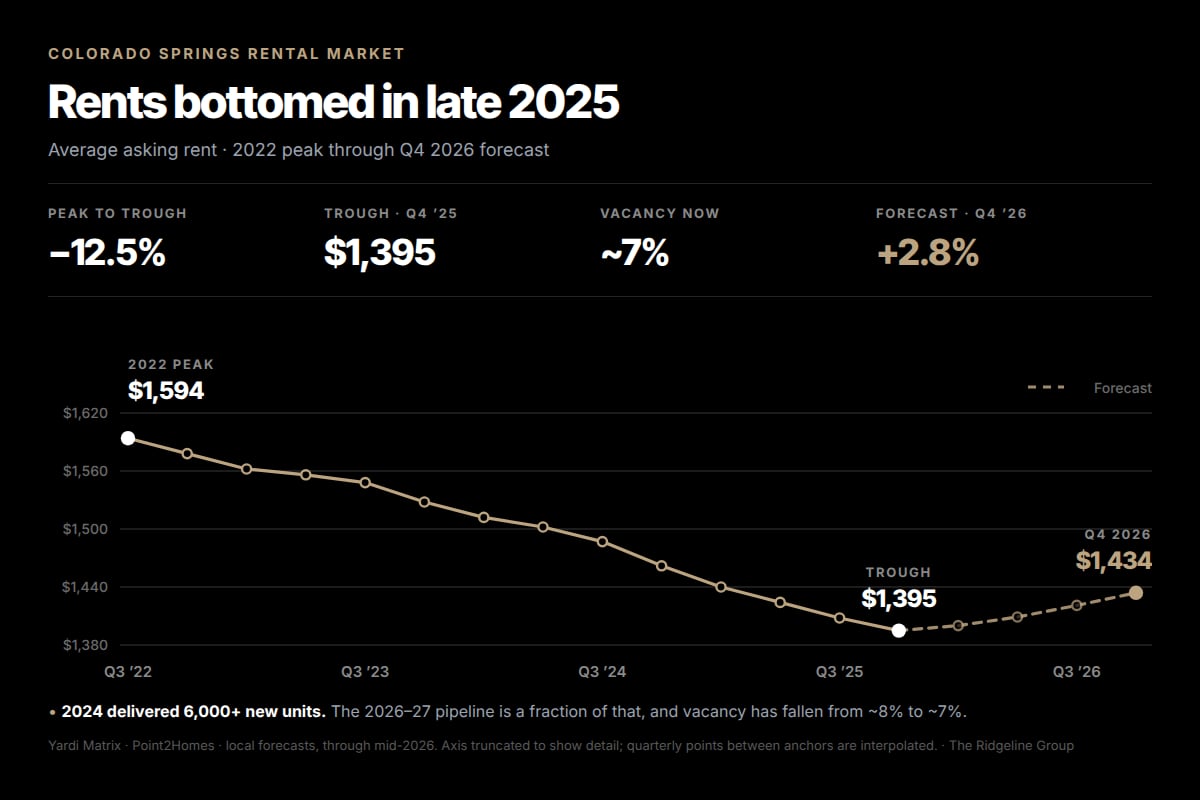
Colorado Springs built a lot of apartments in a short window — 2024 alone brought more than 6,000 new units to the metro. Predictably, rents fell. Average rent dropped to about $1,395 by the end of 2025, its low point of the cycle, down from a 2022 peak. National reports put Colorado Springs rents down around 12.5% from that peak.
That's the bad news, and it's real. Here's the other half:
- He construction pace is falling back toward historical norms — a fraction of the recent flood — with far fewer units scheduled to deliver in 2026 and 2027.
- Multifamily vacancy sat near 7% in early 2026, down from roughly 8% at the end of 2025, and it's still tightening as absorption outpaces new supply.
- Concessions (free months, waived fees) have been shrinking as buildings fill up.
- Local forecasts already have rent growth returning — on the order of 2.8% by the fourth quarter of 2026 — as the supply wave clears.
Put simply: supply is drying up while demand holds steady. That's the setup that produces rent growth on the back end. If you buy while rents are soft and the new-construction pipeline is emptying, you're buying near the bottom of the rent cycle instead of the top.
Where I'd Focus in Colorado Springs in 2026
I'm not going to hand you a "hot ZIP code" list. That's how people buy bad deals. But there are four categories that make sense given the actual conditions:
- Value-add in established east and southeast pockets. Briargate, southeast Colorado Springs, and Fountain keep showing up in commercial reports as value-add territory for a reason — you can still buy below replacement cost and force value through renovation instead of waiting on the market. In a flat-appreciation year, forced equity beats hoped-for equity every time.
- Small multifamily and dual-income properties. Duplexes, homes with legal accessory units, and properties with a separate cottage or basement suite. Two income streams under one roof holds up much better when rent growth is soft. These trade thin in our market, so they take patience.
- House hacking — especially with a VA loan. If you're active duty or a veteran, this is the most underused strategy in Colorado Springs. Zero down on a multi-unit you live in, tenants covering a chunk of the payment, and you keep your entitlement working for you. The VA's official home loan program page is the right place to confirm current eligibility and entitlement rules before you plan around it.
- Builder inventory with real incentives. Builders are still buying down rates and covering closing costs to move standing inventory. On a rental pro forma, a 1.5% permanent rate buydown does more for your cash flow than three years of 2% appreciation. I wrote more about that dynamic in why this may be the best time to buy a brand-new home.
Where I'd be cautious: short-term rentals in over-saturated pockets, anything that only pencils if you assume 5%+ appreciation, and Class C properties where deferred maintenance eats the spread.
How to Underwrite a Colorado Springs Deal This Year
Four things I'd check on every property before you get emotionally attached:
- Underwrite appreciation at 2%, not 6%. If the deal still works, you have a deal. If it only works at 6%, you have a bet.
- Pull actual rents, not Zestimates. Rents softened unevenly across the metro. A number that was true in 2023 is not true today.
- Budget for insurance. Premiums here have climbed hard. It's one of the most common line items I see investors underestimate.
- Negotiate. Seriously. With 45-day market times and nearly half of listings taking a price reduction at some point, sellers are far more workable than they were three years ago. Investors are routinely getting 2–5% off list.
One more thing on valuation: don't accept a low appraisal as final. On a deal last year, an appraisal came in under the contract price. I took the listing agent's Reconsideration of Value letter, rebuilt it with the comparable detail that was missing, and the appraiser came back $22,000 higher. That $22,000 was the difference between closing and walking. Numbers are arguable when you bring evidence.
If you're weighing whether to pull equity out of a property you already own to fund the next one, this breakdown of how equity shapes your options is a good starting point.
Bottom Line
- Colorado Springs appreciation trends are flat to modestly positive for 2026 — plan for 0–3%, not double digits.
- The economic base (Fort Carson, Space Force, defense contracting) is expanding, not shrinking. The $250M Space Force facility and the acquisition-authority move to Peterson are long-term tailwinds.
- Rents are near the bottom of their cycle while new apartment deliveries fall back toward historical norms through 2027. That's the timing worth paying attention to.
- Returns this year come from buying right, forcing value, and financing smart — not from waiting on the market.
- Underwrite conservatively, negotiate hard, and verify rents property by property.
If you're relocating here or PCSing in, the Colorado Springs Relocation Guide and our guide to Colorado's key military bases will save you some time. And you can always check current rate movement directly at Freddie Mac's weekly mortgage rate survey.
Have Questions? Let's Talk
If you're trying to figure out whether a specific property pencils, send it to me. I'll run the numbers with you and tell you honestly if I'd buy it — including when the answer is no.
Brandon Lecocq — The Ridgeline Group, brokered by Epique Realty
- Phone: (719) 413-6610
- Email: [email protected]
Want this kind of market read every week? The Ridgeline Rundown covers Colorado Springs numbers, local happenings, and what's actually moving — in about three minutes. Sign up for the newsletter here.