Home insurance costs in Colorado Springs are hard to pin to one number. Published averages for $300,000 in dwelling coverage range from about $2,984 to $5,804 a year, depending on whose methodology you use. Estimates generally run above national benchmarks, though the comparisons vary by methodology. Hail — not wildfire — is the main reason.
What does Home Insurance Actually Cost in Colorado Springs?
If you've searched this already, you've seen four different numbers. That's not a mistake on anyone's part. Each source uses its own homeowner profile, coverage limits, deductible, and carrier mix, so the outputs don't line up.
Here's what the major comparison sites published, with the assumptions attached:
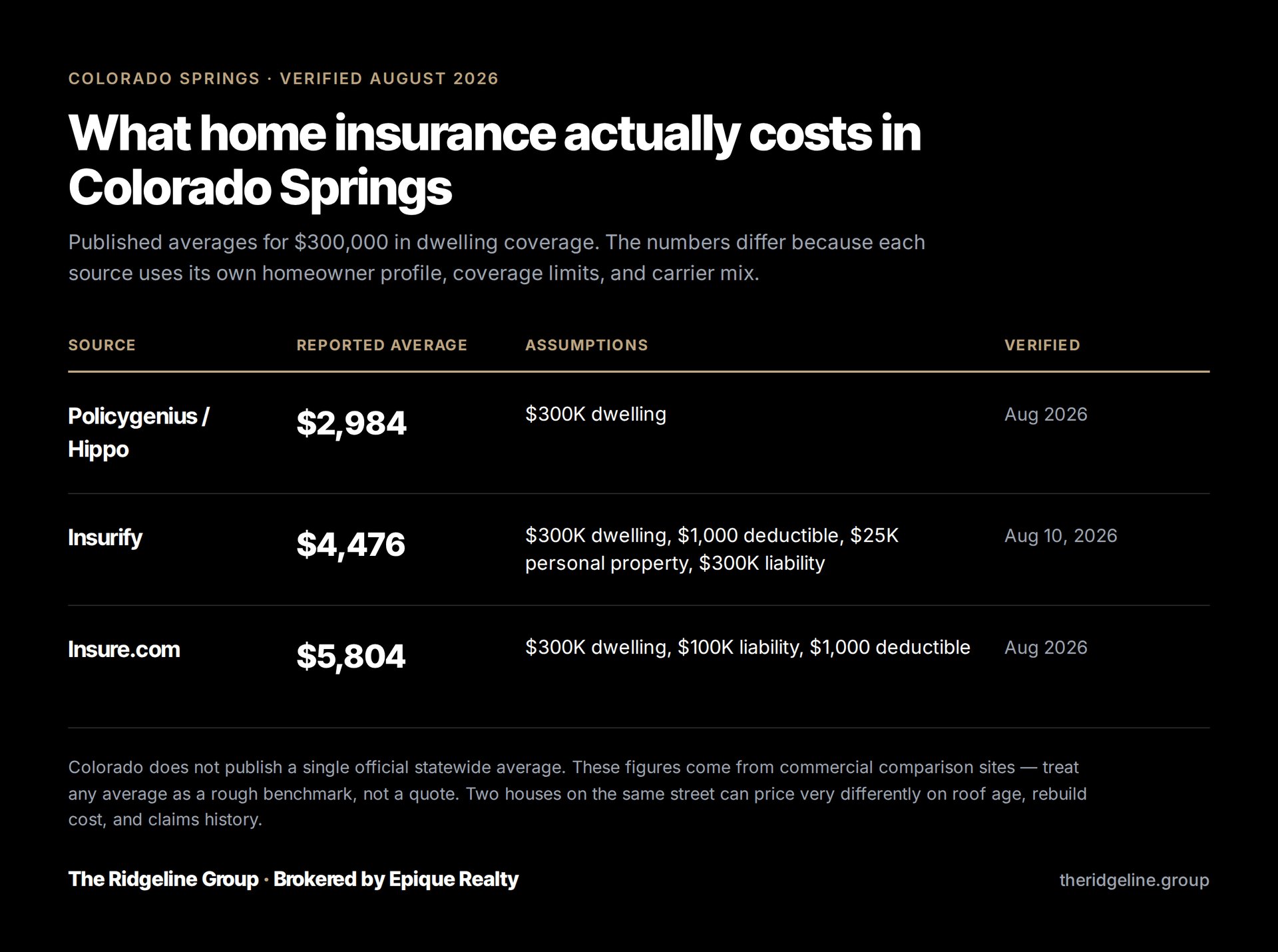
In plain text, for anyone skimming: Policygenius and Hippo report $2,984 a year, Insurify reports $4,476, and Insure.com reports $5,804 — all for $300,000 in dwelling coverage.
One thing worth knowing: Colorado does not publish a single official statewide average. The numbers you see in the press come from commercial comparison sites. What the state does publish is county-level data gathered from 20 carriers representing about 80% of the market — Denver County averaged $3,040, for example.
Treat any published average as a rough benchmark, not a quote. Two houses on the same street can price very differently based on roof age, roof material, claims history, rebuild cost, and distance to a fire station.
Statewide, Colorado premiums have roughly doubled between 2018 and 2024, per Division of Insurance data cited in the Governor's Roadmap to Reduce Homeowners Insurance. Colorado now ranks among the most expensive states in the country.
Why Hail — Not Wildfire — Drives Your Premium
This is the part most people get backwards. Wildfire gets the headlines. Hail gets your money.
In February 2026, the Colorado Division of Insurance surveyed 20 carriers representing about 80% of the state's market and broke the results out across 11 counties — El Paso County among them.
Here's what the state found for us, straight from the DOI's published findings:
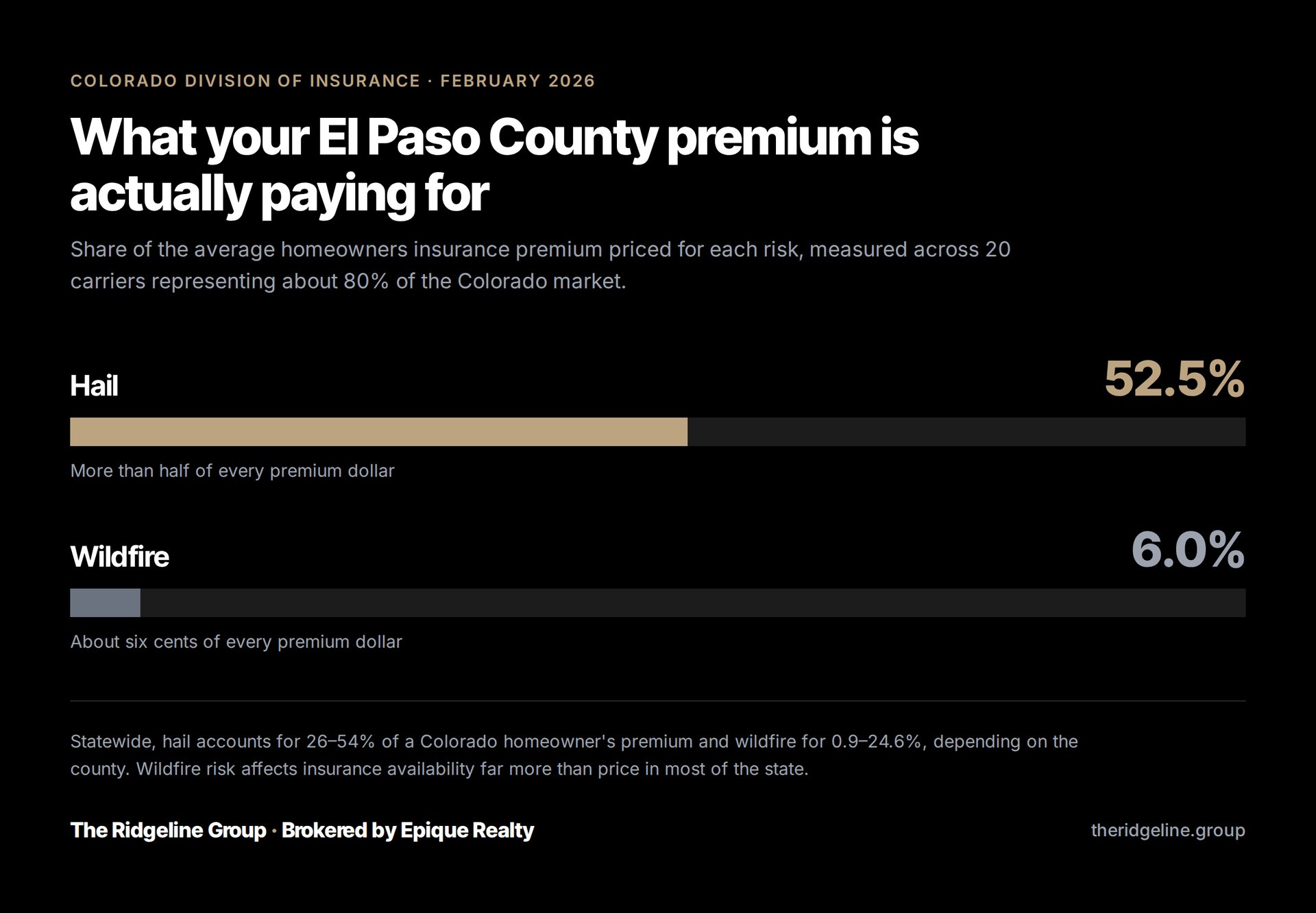
Statewide, hail accounts for 26% to 54% of a homeowner's premium depending on the county, and wildfire accounts for 0.9% to 24.6%. El Paso County sits at the top end of the hail range and the low end of the wildfire range.
Read that table again, because it's the whole story: more than half of what you pay to insure a home in El Paso County is priced for hail. By comparison, wildfire accounts for about six cents of every premium dollar.
That doesn't make wildfire irrelevant here. It means wildfire affects availability more than price. In the foothills and the wildland-urban interface, the problem often isn't the premium — it's finding a carrier willing to write you at all.
Colorado sits in the middle of Hail Alley and has ranked second only to Texas nationally for hail claims. If you've owned a home here through a couple of spring storms, you already knew that.
The Wind and Hail Deductible is the Number That Surprises People
Ten years ago, most policies here carried a flat $1,000 deductible for everything. That has been changing.
Many Colorado policies now use a separate wind and hail deductible expressed as a percentage of Coverage A — the amount it would cost to rebuild your home — rather than a flat dollar amount. That percentage may be 1%, 2%, or another figure depending on the policy and carrier, and older roofs sometimes carry a higher one. It's calculated on your dwelling limit, not on your roof and not on what you paid for the house.
Here's what those structures look like in real dollars:
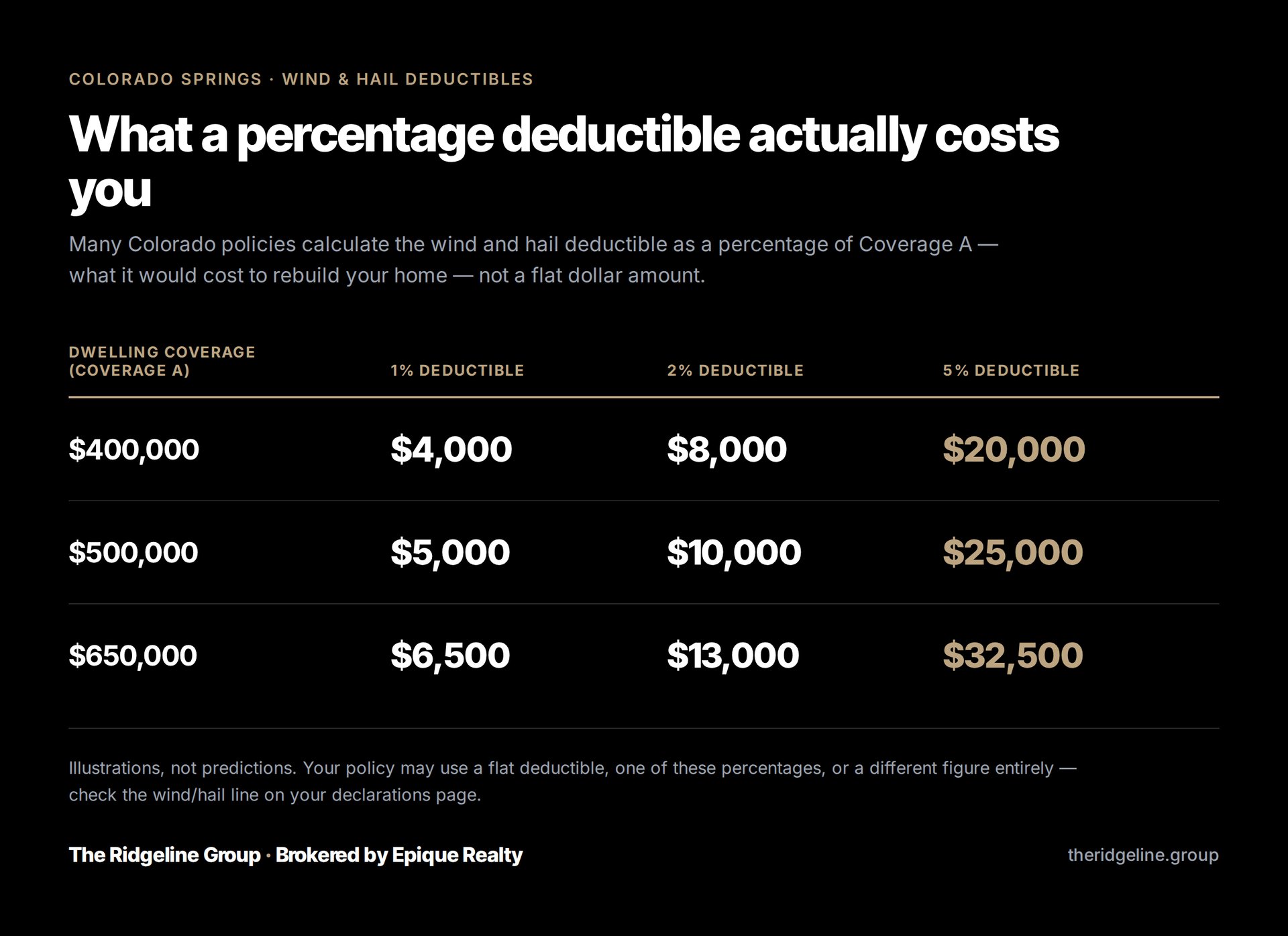
Those are illustrations, not predictions. Your policy might use a flat deductible, a percentage, or a different percentage entirely.
The point is to know which one you have before the storm, not on the claim summary afterward. Pull your declarations page and find the wind/hail deductible line. If it's a percentage, do the math today.
Two more things worth knowing:
- A wind and hail deductible buy-down policy exists — a small standalone policy that helps offset a high percentage deductible. Ask your agent to price it.
- In Colorado, residential roofing contractors are prohibited by law from paying, waiving, rebating, or promising to waive your deductible. If someone offers, walk away.
ACV vs. Replacement Cost: The Line That Decides Your Payout
Second thing to check on your declarations page, and it matters as much as the deductible.
- Replacement cost (RCV) generally pays the covered cost to repair or replace damaged property with comparable materials — subject to your deductible, policy limits, exclusions, and policy terms.
- Actual cash value (ACV) pays the depreciated value, factoring in the roof's age and wear.
On a 15-year-old roof, the ACV settlement can be a fraction of what a new roof costs, and you cover the difference. Some policies also use a roof payment schedule, which steps the payout down as the roof ages, and some carry a cosmetic damage exclusion for dents that don't affect function.
There's also a timing piece. With many replacement-cost policies, the insurer initially pays the actual cash value, then releases the remaining recoverable depreciation after the covered repairs are completed and documented. Which loss settlement your policy uses determines whether that second payment is available at all.
What Actually Lowers Your Home Insurance Costs Here
Not every tip on a generic savings list moves the needle in Colorado. These are the ones tied to our actual risk:
- Install a Class 4 impact-resistant roof. Across the 11 counties studied, the Division of Insurance found hail mitigation has the potential to save consumers $82 to $387 per year — versus just $3 to $25 for wildfire mitigation. CPR News reported that the state calculated the potential El Paso County savings at about $388 a year on average, at the top of that statewide range. Actual discounts vary by carrier and by home. The bigger benefit is insurability — impact-resistant roofs keep more carriers willing to quote you.
- Choose your deductible deliberately, and keep cash set aside to match it. A higher deductible lowers premium only if you can actually absorb it.
- Think before filing a small claim. Repeated claims can affect your premium and your carrier's willingness to renew. Compare the repair estimate against your wind and hail deductible first.
- Bundle home and auto, and ask for every mitigation credit — roof class, water shutoff, monitored alarm.
- Compare quotes at renewal. Carriers regularly update their Colorado pricing and underwriting, so last year's best rate may not be this year's.
- Watch the new state program. Senate Bill 26-155, signed June 4, 2026, created the Strengthen Colorado Homes Enterprise inside the Division of Insurance to fund grants for resilient roof retrofits. The funding mechanism begins in 2027, and the board and application process are still being stood up — details will post at the Colorado Division of Insurance.
What a Standard Policy Does Not Cover
A standard HO-3 policy covers wind and hail. It does not cover everything people assume.
- Flood. Never included. You need a separate policy through the FEMA National Flood Insurance Program or a private flood carrier. Burn-scar runoff is a real consideration on the west side.
- Earth movement. Expansive soils are common along the Front Range, and foundation movement is typically excluded.
- Cosmetic hail damage, if your policy carries that exclusion.
- Full rebuild cost, if your dwelling limit hasn't kept pace with construction costs. Review it annually.
If the standard market has declined you, the Colorado FAIR Plan exists to provide a coverage option for eligible properties that can't obtain coverage elsewhere. It uses actual cash value settlement, and wind and hail are purchased as additional coverage rather than being built into the base policy.
Eligibility rules — including how many declinations you need — are set by the Plan and can change, so confirm the current requirements with the FAIR Plan directly or through the Division of Insurance. It's a last-resort option, not a guarantee of acceptance.
How Insurance Affects Buying and Selling a Home Here
Insurance has quietly become a deal issue in Colorado Springs, not a closing formality.
If you're buying: get an insurance quote during your inspection objection period, not after. A 20-year-old roof, a prior hail claim on the property's CLUE report, or a wildfire risk score can change your quote significantly — or make the home difficult to insure. That's information you want before your objection deadline, not at final walkthrough. It matters more on VA and FHA financing, where the appraisal carries its own roof condition requirements.
If you're selling: roof age is now one of the first questions a buyer's insurance agent asks. A documented roof replacement, an impact-resistant upgrade, and a clean claims history are selling points worth putting in the listing.
I connect clients with a local insurance agent early — usually at the same time as the lender. It's one call that prevents a much worse conversation later.
FAQ
Why is my home insurance so high in Colorado Springs? Hail. The Colorado Division of Insurance measured it county by county in February 2026 and found hail accounts for 52.5% of the average El Paso County premium, versus 6.0% for wildfire. Add rising rebuild costs and tighter underwriting, and Colorado ranks among the most expensive states.
What is a normal wind and hail deductible in Colorado? Many Colorado policies use a percentage of dwelling coverage rather than a flat dollar amount. The percentage may be 1%, 2%, or another amount depending on the carrier and policy. On a $500,000 dwelling limit, 2% works out to $10,000 out of pocket. Your declarations page lists your exact structure.
Does a Class 4 roof lower my premium? It can. State analysis found hail mitigation has the potential to save Colorado homeowners $82 to $387 a year, with El Paso County reported near the top of that range at about $388. Actual discounts vary by carrier and home. The larger benefit is insurability.
Will filing a hail claim raise my rates? It can, and repeated claims can affect your carrier's willingness to renew. Compare the repair estimate to your wind and hail deductible first. If the estimate is close to your deductible, talk through the potential claim and its implications with your insurance agent before deciding whether to file.
Do I need flood insurance in Colorado Springs? Only some homes do, but flooding is never covered by a standard policy. Check your address on the FEMA Flood Map Service Center, and pay attention if you're downhill of a burn scar.
How fast do I need to file after a hailstorm? Sooner than you think — policies limit the window after the date of loss. Document the storm date, photograph everything from the ground, and contact your carrier before you contact a contractor.
Key Takeaways
- Published averages for a $300,000 dwelling policy in Colorado Springs range from about $2,984 to $5,804 a year depending on methodology. There is no single official number.
- In El Paso County, the state measured hail at 52.5% of the average premium and wildfire at 6.0%. Hail drives the premium; wildfire drives availability.
- Check two lines on your declarations page: the wind/hail deductible structure and whether your roof settles at ACV or replacement cost.
- A Class 4 roof is the highest-leverage upgrade here — the state estimates $82 to $387 a year statewide, with El Paso County near the top of that range, plus better insurability.
- Get an insurance quote before your inspection objection deadline when you're buying.

Have Questions About Your Coverage?
If you're buying, selling, or just trying to figure out whether your policy actually protects you, reach out. I'll walk you through what to look for and connect you with a local insurance agent who knows this market. No pressure, just answers.
Brandon Lecocq — The Ridgeline Group
- Call or text: (719) 413-6610
- Email: [email protected]
Want the Colorado Springs market in your inbox every week? Sign up for the newsletter here.